

Ordering bricks and looking for a quick and easy way to figure out how many you're going to need? Read our information about standard brick coursing charts to understand more.
What is a brick coursing chart?
A brick coursing chart is a helpful document used by bricklayers, builders and architects to help them calculate how many bricks they're going to need to build a wall of a particular height or width. It can also be a handy quick reference for those looking to renovate or build their own homes.
A 'course' is a measurement referring to the dimensions of the brick AND mortar when they have been sandwiched together. One brick and the mortar together is equal to one 'course'.
As bricks come in a variety of dimensions and sizes that can be tricky to multiply accurately, a brick coursing chart is an easy way to make sure you're ordering and using the right amount of bricks for your project, also ensuring you avoid costly mistakes.
Brick coursing charts are also useful for calculating the different needs for internal and external bricks; for example, you might be using a Commons brick for the exterior of your home, and then a thinner, more linear brick for internal decorating. With a brickwork coursing chart, you'll be able to easily figure out how many bricks you need for each section based on their size.
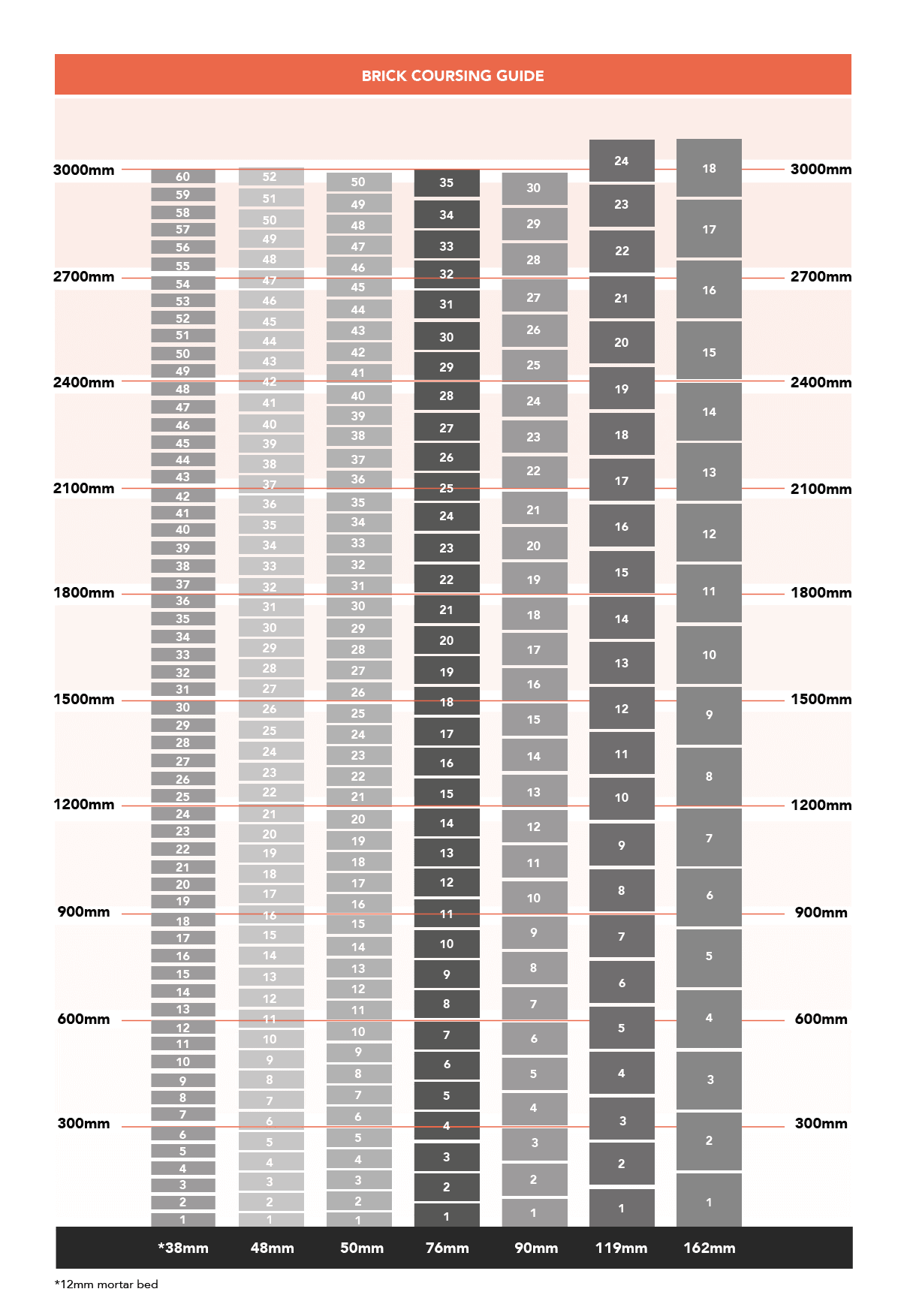
How to use a brick coursing chart
Brickwork coursing charts are fairly simple to use. Just measure the area you're wanting to lay with brick (or have the measurements on-hand), choose the size of brick you'll be using, and then find the corresponding number of courses for the size of your brick and your project.
For example, if you've chosen a ceiling height of 35C and you're using the standard Australian size 76mm brick, then this means that your home's ceiling will be built using 35 courses of brick.
Whatever brick you choose, our brick coursing chart is an invaluable document to help you with your brickwork project. The PGH brick coursing chart is a part of our Technical Manual, which provides helpful advice and guidance when it comes to working with brick. To request a free download of the Technical Manual click here.
Download Technical Manual
Remember - if you need help or advice, you're more than welcome to give us a call on 13 15 79, pop into one of our Selection Centres to see our bricks. Alternatively, fill out the form below with your enquiry and we'll get back to you.

Sign up to receive the PGH newsletter
Be in the know about future product releases, new products, events and trends.